A jiu-jitsu belt is a useful signpost, but it is a poor stopwatch. Two people wearing the same color can have different training histories, competition experience, physical attributes, and goals. Understanding rank means learning what the colors communicate without turning them into promises about who will win a round or how quickly somebody should be promoted.
This guide separates three ideas that are often mixed together: an instructor awarding a belt, an organization recognizing eligibility, and a competitor earning a position in a ranking table. They can overlap, but they answer different questions. Start with the progression, then use the practical learning framework below to discuss your own development with your coach. The framework is a planning tool, not a universal promotion examination.
The adult belt sequence
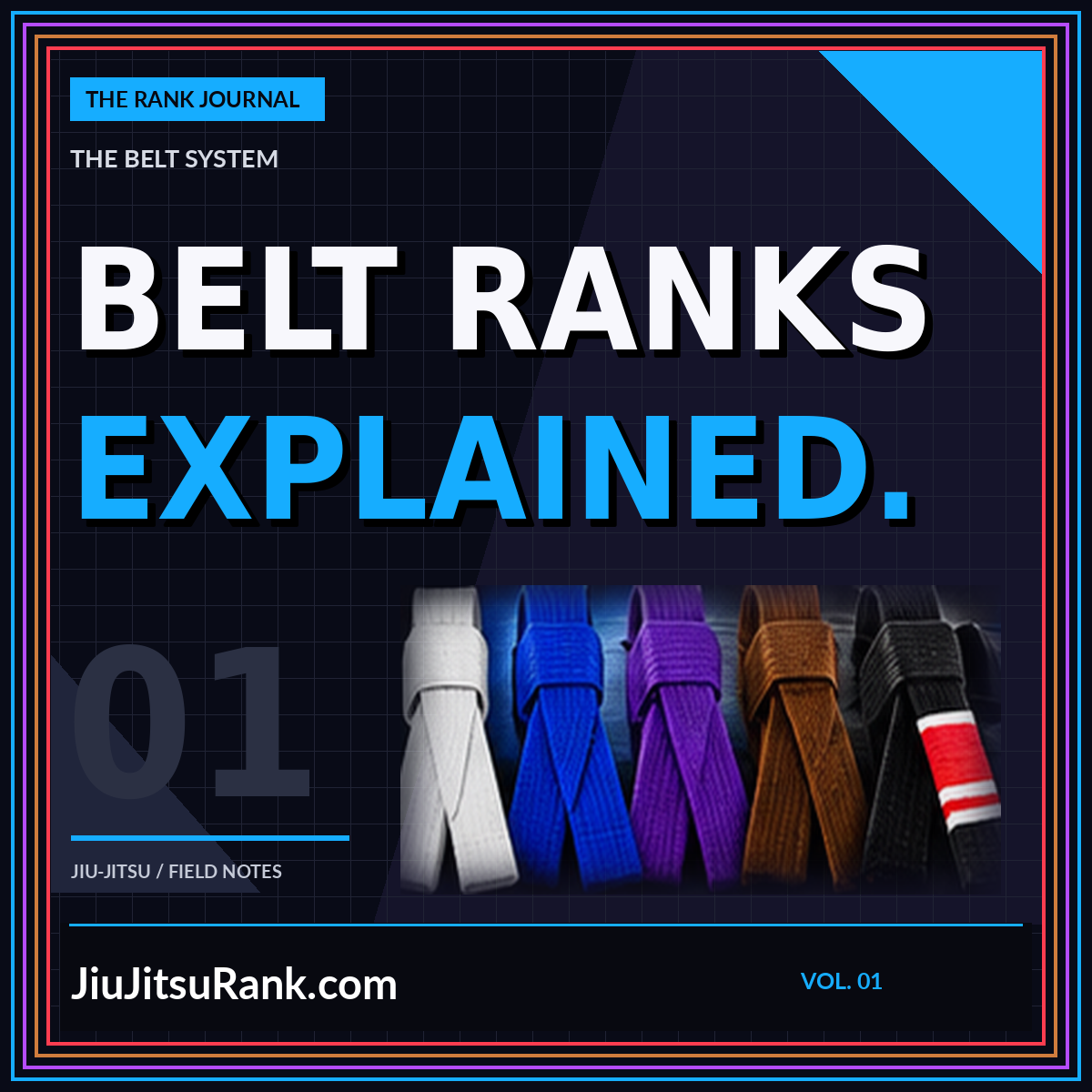
The familiar adult progression is white, blue, purple, brown, and black. Senior degrees extend beyond the first black belt; children's pathways use additional colors and should not be interpreted as a smaller version of the adult sequence. For formal age, time, and degree requirements, consult the IBJJF graduation system, rather than relying on a social-media chart with no edition or source.
An important distinction follows: a federation's minimum requirement is not an appointment for promotion. Your instructor still needs to evaluate your training within the academy's standards. Likewise, an academy's expectations should not be represented as identical to every other school. Ask which system your school follows, how progress is discussed, and what documents matter if you intend to compete. Clear answers are more useful than a vague promise of a belt after a fixed number of classes.
White belt: build a map before collecting moves
A productive white-belt goal is to recognize where you are and what the immediate problem is. Can you distinguish guard, side control, mount, and back control? Can you explain whether you need to recover space, protect an exposed position, or establish a stable base? These questions give structure to what can otherwise feel like a continuous series of unfamiliar movements.
Make the first learning cycle small. Choose one starting position from class, ask your instructor for its key safety boundaries, and practice recognizing the same situation with a cooperative partner. During supervised positional work, notice the moment your original plan stops working. Recording that moment is more useful than writing that an entire round was bad. Treat tapping, respecting a partner's limits, and stopping when the instructor asks as core training skills, not interruptions to the technical work.
Blue belt: connect the pieces
For your own development, think of blue-belt study as an opportunity to connect positions rather than merely increase the number of techniques you can name. A guard option should have an answer when an opponent changes posture. A passing approach should lead to control rather than end the moment you clear the legs. An escape should give you a workable next position instead of a brief sense of relief.
Draw a simple route on paper: starting position, first objective, likely response, and next decision. Keep the route limited enough that you can test it in a few supervised rounds. A useful review question is, “Did I recognize the response before I tried the next action?” This turns an apparent plateau into a specific observation. It also makes feedback easier for your instructor, because you can describe a decision rather than ask for a complete solution to your whole game.
Purple belt: make choices more deliberate
A helpful purple-belt study theme is decision quality. Instead of asking only whether a technique worked, consider why you selected it, what information you noticed, and what alternatives were available. You may discover that a familiar sequence works against one response but that you keep forcing it when the opponent gives you a different problem.
Use contrasting rounds to explore that question. In one round, focus on recognizing your preferred entry. In another, start from the less comfortable side or position, under your instructor's supervision. Compare the decisions afterward without treating either round as a promotion test. The goal is to make your choices explainable. That process can expose gaps hidden by a strong favorite technique while preserving the useful parts of a developing personal style.
Brown belt: examine the transitions
For a brown-belt learning project, look at the spaces between the positions you already understand. Where does control disappear during a switch? When do you pause without a clear reason? Which reactions cause you to abandon an otherwise sound route? Those questions are specific enough to investigate without needing to replace your entire game.
Choose one transition and study several examples from your own permitted training footage or written notes. Separate the setup, the actual change, and the stabilization afterward. Ask a coach to identify which part deserves attention first. A round can end in the position you wanted while still containing a fragile transition. Conversely, a failed attempt can reveal a useful adjustment. This approach values the quality of the process rather than rewarding only the final result.
Black belt does not mean the learning is finished
A first black belt is not a claim that someone knows every technique, wins every match, or can teach every student equally well. Treat the rank as one piece of context. Competition achievements, teaching experience, communication, and professional conduct are separate questions that deserve separate evidence. A technically accomplished competitor can still need to develop coaching skills, just as an excellent teacher may not maintain an active competition schedule.
For readers using a black belt directory, look for clearly described records and sources rather than impressive-looking badges alone. For practitioners, continue to define learning projects that can be observed. The belt should support a more mature relationship with feedback, not make feedback unnecessary. There is room for specialized competitive ambitions, broader technical study, and helping a training room become more welcoming.
Stripes, timelines, and comparisons
Avoid assuming that stripes have exactly the same meaning everywhere. Ask your academy how it uses them. An attendance marker, a technical milestone, and an instructor's overall assessment are different signals. Comparing two students' stripes without understanding the system can create a disagreement where none exists.
The same caution applies to timelines. Work schedules, family responsibilities, previous grappling experience, interruptions, and the structure of available classes can make two training histories difficult to compare. Instead of building a deadline around someone else's promotion story, agree on a small set of current objectives with your coach. Keep a record of attendance and questions, but do not convert the record into a demand. Progress conversations are more constructive when they begin with what you are learning, not what another student received.
A practical review before your next class
Write down one position you recognize reliably, one transition you often lose, and one rules question you need answered. Bring the shortest useful version of that list to your instructor. Ask which issue should become your next training priority. You do not need a complicated spreadsheet or a public ranking of your teammates; a page of clear observations is enough.
Review the same questions
After several classes, revisit the same questions. Look for a more accurate explanation, a better decision, or a more controlled response. Those changes are worth noticing even when the belt stays the same. To keep the concepts separate, compare this guide with our explanation of global BJJ competition rankings. A points table measures a defined competition record; it is not a replacement for an instructor's assessment.
Conclusion: use the belt as context
Understanding jiu-jitsu rank is most useful when it improves your questions. Learn the color sequence, check the relevant organization's requirements, and ask your instructor what development looks like in your academy. Then build a manageable learning project around positions, decisions, and transitions. Respect the meaning of a promotion without asking it to explain every difference between practitioners. The next useful step is not always the next color; often it is seeing one familiar situation more clearly.


